Wednesday, May 1, 2013

What I’m Reading, April 26, 2013

I’ve been a bit of a whirlwind reader this week, plowing through a myriad of YA and adults reads with an incessant need to find something really great. Instead, I found myself faced with a mixture of sequels, odd and slightly disturbing new titles, and disappointing series finales. So, in the order I read them, here’s what’s been in my hands this week.

Black City by Elizabeth Richards (out now)
Okay, this is a bit of a cheat, because I actually read it last Friday, but I thought I would mention it anyway. Black City is another one of those dystopian young adult novels that deals with a corrupt totalitarian government ruling with an iron grip. It differs in that author Elizabeth Richards introduces a bit of a paranormal concept, where Darklings, mutated humanoid-vampire creatures, are the “villainous” others struggling against serious segregation propaganda from the anti-Christ type leader of the humans. Here, the daughter of a corrupt government official/scientist falls for a twin-blood (the product of a human and a Darkling) without a heart. Between extreme religious parallels and violence (really horrific crucifixions of traitors to the government’s cause), and obvious comments on bigotry, segregation, and totalitarianism; the underlying themes are definitely unsubtle—more like a sledge hammer, and the plot suffers for it. Still, the world was interesting enough to keep me reading and the writing was not horrible. I have the sequel, Phoenix, but am still unsure if it deserves my time. I have to say, this book is not for the weak of stomach, or heart, and although it is geared toward those ages 14 and up, I would be hesitant to recommend it to anyone under the age of 17. In all, Black City was not a complete waste of time—it did mash-up genres in an interesting way, but in all, the extremes that it uses to push political, social, and religious tones onto a teen reader takes away from its likability.

Emerald Green by Kerstin Gier (releases 10/8/13)
The final book of the Ruby Red series was a bit of a disappointment. Ruby Red had a lot of promise, an interesting storyline, a likeable heroine, and an interesting twist (see my review Ruby Red: An International Bestseller Making its Way to the U.S.). I found the sequel, Sapphire Blue to be lacking a bit, but let’s face it, most of the middle books within a trilogy do, and still I had hope for a good strong finish. Unfortunately, Emerald Green just didn’t have it. While the primary plot threads were closed, there were still many holes left untouched, and there was a rather unsatisfying handling of what should have been a rather pivotal and emotional reveal for the main character. Basically, I experienced a general feeling of let-down. I don’t know if the better part of the series plot and character development was lost in translation (translated from German by well-known translator Anthea Bell), or if in stretching it to three books, as opposed the one single novel—after all the entire series only takes place over a few weeks—took the spark away, but whatever it was, the finished product was sadly lacking in oomph and pay-off.

The Elite by Kiera Cass (out now)
Yes, I did hit the YA hard this week, and the third book I read is the sequel to last year’s The Selection (for review see "The Selection"—read it before you see it). The Elite continues to follow the story of America Singer, a poor musician living in yet another dystopian setting, who has been recruited to compete in a very public Bachelor-esque competition for the hand of the kingdom’s prince in marriage. In book two we find America, now one of six remaining girls, torn between her confusing feelings for Prince Maxon and her childhood love Aspen, now in the Royal Guard. The machinations of the other girls are fascinating to read about as they continuously vie for attention and the crown, and the underlying political happenings start to take on for meaning—making it a little difficult to figure out exactly how this series will end. Despite its middle book-syndrome premise (nothing ever comes to resolution in the second books), The Elite is still engaging, though often maddening (just choose a guy!), and worth a read if you enjoyed The Selection. I can’t help, but anticipate the yet to be named conclusion to this trilogy, I truly have no idea how it will end.

The Last Word by Lisa Lutz (releases 7/9/13)
I always enjoy the wit of a Spellman book and The Last Word, which is the 6th “document”, continues the story of Isabel Spellman and her wayward family of Private Investigators. This time the perpetually sarcastic Izzy is losing control of her recently conquered company (she sprung a takeover of the family’s business in Document #5, Trail of the Spellmans)—her parents refuse to behave themselves in any sort of professional manner, her top client and backer makes her jog three times a week, and she’s under investigation by the FBI for embezzlement. Lutz’s characters are sarcastic, sneaky, and downright scary in their ingeniousness. While not my favorite of the series—that’s a tie between The Spellman Files and The Spellmans Strike Again—the characters are still endearing and entertaining, making it of course, a must read for fans of the series.

The Fairest of Them All by Carolyn Turgeon (releases 8/16/13)
This reimaging of the Rapunzel and Snow White stories is a dark and twisted piece of fiction. Ostensibly telling the story of Rapunzel, The Fairest of Them All features the long haired beauty as an amalgamation of the innocent young maiden from the tower and the misunderstood, possibly wicked, Evil Queen from the Snow White tale. This Rapunzel, raised by a witch, enchants the less than perfect prince, only to be ditched by him when he marries the mother of the yet to be born Snow White. What ensues is heartbreak, mischief, love, and revenge as the amazingly naïve young lady with the magic hair evolves into an entirely new and unique version of Snow White’s stepmother. An interesting and definitely adult fairytale remake, I can’t quite say I liked it—these characters were almost too human in their flaws, too dark in their thoughts and deeds, heroes and villains alike, but it might be worth a read if you’re in the mood for a skewed trip into the “happily ever after” zone.

I also read The Never List by Koethi Zan (releases 7/16/13), but will be discussing it later in a full review.

I’m currently reading Rick Yancey’s The Fifth Wave, a post-apocalyptic YA that is looking to be very promising. More on that later.

Creative Commons License
This work is licensed under a Creative Commons Attribution-NonCommercial-NoDerivs 3.0 Unported License.

Thursday, April 18, 2013

"The River of No Return"

Fans of Deborah Harkness’s A Discovery of Witches rejoice—The River of No Return is here!

No, it’s not another book in the Witches series, and no it is not another book from Harkness herself. Instead, it is a debut novel written by another professor (Harkness is at USC); this time by a professor of English literature at Bryn Mawr College, Bee Ridgeway, and her story is 100% sure to grab your attention and devotion if you are a fan of Harkness.

The River of No Return (not to be confused with the Robert Mitchum/Marilyn Monroe film) follows the story of Nick Davenant, nee Lord Nicholas Falcott, a young man thrust through time during the heat of battle in 1813, landing in 2003 to discover he has a unique gift, one that allows for the manipulation of time. It is there that he is taken under the wing of the Guild, a group of powerful men and women with the same abilities as Nick. Ten years later, Nick is plunged through time once again, this time by the Guild, in order to investigate a terrible hole (called “the Pale”) that is threatening the future. Back in his own time Nick is reacquainted with his young love Julia Percy, a Lady with mysterious ties to time, the Guild, and the Guild’s enemies, and who may have the answer to everything.

There is obviously much more to the plot, it’s a fantasy that weaves between time and characters, building itself a rich history and background, laying the groundwork for future sequels. Much like it’s counterparts in fiction, Diana Gabaldon’s Outlander and the Deborah Harkness books, The River of No Return has a plot that is intricately drawn and difficult to describe in detail without divulging too much of the plot (something that drives me crazy in reviews). Yet, unlike the books by Harkness, Ridgeway’s book is much more tightly edited, without the pages of droll description or meandering conversation about subjects that have no real bearing on the plot (wine and yoga in the case of Witches). The pacing is good, and only slows to a squeaking (not quite screeching) halt when the concept of “the River” and time are philosophized upon. The book is of course not without fault. Its characters are interesting, although with a few of them it is clear that the author is trying desperately to give them depth and mysterious undercurrents, but instead reduces them to over-dramatic and somewhat farcical creatures. The writing at times loses its crispness, not the plot mind you, but the writing—something that is more common with debuts, and is sure to be honed by the time the sequel arrives. Also, it does leave readers hanging; a plot device that, in this series driven world of entertainment, is something that seems as unavoidable as death, and yet is done in such a way that readers will not be prone to throwing their books across the room in frustration (yes, I’ve done this) because nothing has been resolved.

In all, The River of No Return is a wonderful read. It is fantasy, it is historical, it is romance, and it is intrigue— all those things that help to create a rich and entertaining narrative. If you love those genres, or are a fan of A Discovery of Witches, you will thoroughly enjoy Bee Ridgeway’s debut, and like me, be eagerly waiting on the next installment. Creative Commons License
This work is licensed under a Creative Commons Attribution-NonCommercial-NoDerivs 3.0 Unported License.

Wednesday, March 20, 2013

Reading & Watching The Searchers

I have a confession. I’m a John Wayne fan. I’m a sucker for movies like McLintock!, The Quiet Man, Blood Alley, and She Wore a Yellow Ribbon, I even have Angel and the Badman on my iPod (yup watched it on that tiny screen on a bus trip once). I’ve even sat through part of The Conqueror, although Wayne as Genghis Kahn is pushing it, even for me. Suffice it to say, I have a soft spot for movies starring “The Duke”. Despite that lifelong fandom, from a young age one movie in particular has always stood out for me as being something more—bigger, richer, dirtier, edgier—a film that at twelve, I knew had depths that I wasn’t quite capable of grasping, yet if asked I would state without hesitation, that it was my favorite Western, and more importantly, my favorite John Wayne film; The Searchers.

I always knew I loved The Searchers, but it seemed like each year I saw it something else would jump out at me as to why it deserved my appreciation. At twelve, it was the revenge story of Ethan Edwards and Martin Pawley hunting down the Indians who massacred their family, at fourteen it was the presence of Natalie Wood as Comanche captive Debbie Edwards (I was in a “Natalie Wood” stage, where I would watch anything and everything with her in it—whole other story), at twenty it was the love story between Martin Pawley and Laurie Jorgensen—how I railed against poor Charlie McCorry—and an appreciation of scope and beauty of John Ford’s film, so gritty, harsh, and beautiful. Now, past thirty, I appreciate the complexity of Wayne’s performance, the overlying themes of racism, women ruined by the taint of Indians, deep hatred, revenge, lost love, and the exclusion from companionship of those incapable of releasing the strongholds of those elements on their souls. I suspect that at age forty I will have even more discoveries to make about this brilliant film, one I consider to be the greatest Western ever made.

After those statements it is clear that it was with great excitement that I picked up Glenn Frankel’s new book The Searchers: The Making of an American Legend. This thoroughly fascinating book looks, not just at the film, but at the true history behind the story The Searchers is loosely related to, that of Cynthia Ann Parker, a nine year old girl abducted by Comanche’s in 1836 amidst the massacre of her family, and the subsequent years following her uncle’s search for her and the other captives, Cynthia Ann’s eventually recovery, and the life of her son, Quanah Parker, a man with historical standing of his own (as chronicled in S.C. Gwynne’s Empire of the Summer Moon). It also delves into Wayne’s rise in fame and his interesting relationship with director John Ford, the film’s reception, and follows-up with the descendants of each player within this expansive history. Frankel manages not to only delve into the making of an American film classic, but to also provide a rich, thoroughly researched history of Texas’s origins, white/Comanche relations, the rise of Comanche chief Quanah Parker, and a look at the history of American westward expansion. This completely readable and brutally honest account of America, spanning from the 1800’s to today, is absolutely compelling. As a fiction reader who typically only reads movie related non-fiction, I was blown away with how enthralled I was with the history behind this stunning film. Frankel writes with the precision of a thorough researcher, the panache of a journalist, the depth and caring of a biographer, and the soul of a film lover. He makes readers yearn to find a showing of The Searchers in a movie theater, and delve into their DVD collections in search of John Ford films such as How Green Was My Valley, or The Quiet Man in order to better view the incredible vision of this great director. His glimpse into the story of the Parker family even pushed me towards Empire of the Summer Moon, a book that typically would not even garner a glance from me. It takes master storyteller to convey so much in a book that is more history and criticism than exciting thrill ride.

The Searchers: The Making of an American Legend will make you want to revisit history. It will drive readers toward a renewed or even brand new interest in the evolution of the American West and it will reintroduce the character of John Wayne—someone so much more than the Rooster Cogburn that is so indelibly etched into today’s movie watchers—showing them the lonely, tortured depths he was able to obtain as Ethan Edwards. These two, book and film, are perfect companions, a lovely blend of history and movie magic, created by virtuosos and should be read by every American history and film buff out there.

Creative Commons License
This work is licensed under a Creative Commons Attribution-NonCommercial-NoDerivs 3.0 Unported License.

Thursday, February 21, 2013

What I’m Reading, February 21, 2013

This week I tore through Benjamin Percy’s upcoming (5/7/13) alternate history/paranormal/horror novel Red Moon, only to be disappointed in the Justin Cronin-like ending ‘ala The Passage, that leaves more questions unanswered than answered. The general plot is intriguing—imagine that instead of civil rights marches in the 60’s, and groups like the Black Panthers, the world was dealing with an altogether different race battle, one between humans, and humans infected with a lobos prion that turns them into lycanthropes—yup, werewolves, or in the case of this book, Lycans. So, think Freedom Marches with Lycans, instead of African Americans and how that history would be reflected in the lived today’s 21st century Lycans.

I liked the alternative history angle, putting the Lycans into the place of African Americans was interesting, and Percy seamlessly ties that past into the stories of the three primary characters living in our current time. Percy integrates college sit-ins, holocaust-like settings and persecutions for Lycans, Occupy-like protests, genetic testing, and dirty politics into a rich and complicated plot. Unfortunately, once the reader has invested time into the 544 page novel; he/she is left hanging, with no real satisfaction. I actually threw the book on the floor in frustration upon finishing it. When you invest that much time into a book you want some sort of payoff, and books that leave you with frustration and not anticipation, rarely get the sequel picked-up by readers. Hence the copy of The Twelve that is still sitting by my bed—I think I bear some resentment to my Passage frustration. I liked Red Moon, but I just don’t know if I will read the next book (whenever it comes out, my guess 2014 or 2015) for fear that I will be just as unsatisfied by the ending, or lack thereof. If that’s a style you enjoy, go for it—the story is really good, but if you are like me, with too many books and too little time for that empty feeling at a book’s conclusion—take a pass on Red Moon.

Right now I’m reading Jennifer McMahon’s The One I Left Behind, a gripping novel that follows the aftermath of a serial killer in a small Connecticut town. Written more in a more literary manner than most serial killer books, The One I Left Behind deals not only with the horror of a serial killer; in fact, its primary focus is relationships; those between outcast teenagers, mothers and daughters, family, and how what we perceive is not always what is. A good one for Book Clubs, I’m a fan—I just hope the ending is written well.

Follow-up:

I mentioned in my last post two books I was reading, Gayle Forman’s Just One Day and Carlene Bauer’s Frances and Bernard here's my quick opinion:

Just One Day was a little bit of a disappointment, primarily because the book is clearly set-up for a sequel that is to be told from the perspective of the male protagonist (or antagonist depending on how you look at it), and that takes a bit of the sting out of the emotional impact. Also, perhaps it’s an age thing, but the character’s choices are so off the wall that the believability factor was a bit low. I’ll still read the follow-up, Just One Year, but it will have to be a miraculous piece of storytelling to win me over.

Frances and Bernard was very different than I thought it would be. Slow to start, this epistolary novel was a bit tough to get into. The opening letters were deeply philosophical discussions of faith, dry and dull, with insight into the characters intellects, but lacking the emotional tug that makes readers want to know them more. Yet, once I was able to get into the groove of a story told in letters, both Frances and Bernard’s voices became very clear, with Bauer creating rich and complex characters outside of the bonds of traditional storytelling. Instead, readers are treated to two multifaceted individuals, whose friendship, and complicated love story is both bittersweet and intellectually stimulating. Not my usual “cup of tea”, but highly satisfying in terms of character development and voice. In all, Frances and Bernard was a wonderful surprise of a read.

Creative Commons License
This work is licensed under a Creative Commons Attribution-NonCommercial-NoDerivs 3.0 Unported License.

Friday, February 1, 2013

A Return to Chick-Lit

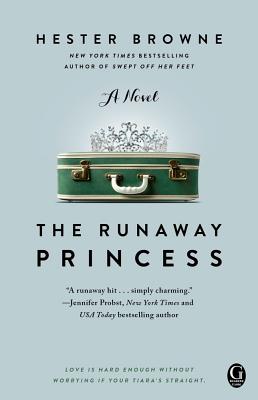
I used to be a chick-lit reader. It was fun, escapist, and just what I needed following years of college and graduate school. Now, I tend toward psychological suspense, dystopian futures, and really good fiction, having eschewed my chick-lit reading to my early twenties. And yet, in the midst of my busy and ridiculous schedule this week, I opted to read, not the new Chevy Stevens ARC that’s been sitting next to my bed for a week, and not the fun new Nicola Upson that features my all-time favorite director Alfred Hitchcock as a character, but a book I grabbed from my pile on a whim, The Runaway Princess by Hester Browne—a definite chick-lit novel.

Maybe it’s because I’m over thinking about serious things (I’ve been dealing with political book signings for the past couple of months and am so ready for the last one to come and go), or maybe it’s because I’m in the midst of planning my wedding and I just wanted to have a light-hearted moment, but whatever the reason, I put off the books I’ve been excited about and picked-up a cheap thrill.

The basic plot of this light read follows London garden designer Amy, as she meets Leo, the man of her dreams at a costume party, starts to fall just a little bit in love, and then finds out he’s a prince—one with a super model mother, playboy brother, debonair father, and who happens to be fourth in line for the throne. When circumstances change putting Leo‘s father into the ruling position with Leo right behind him, Amy’s already shaky self-esteem and past family embarrassment lead her into a downward spiral of nerves and mishaps, that just may take her away from her own shining prince.

Predictable—highly. Silly—absolutely. Was the main point of conflict ridiculous—yes. Still, for some reason I still found it enjoyable. Maybe it’s the wedding thing, and the romance (and craziness) of all that comes with falling in love and getting married, but this book was actually fun to read. It’s not exceptional writing, the peripheral characters are poorly developed, and the main character gets a bit annoying with her constant bouts of self-consciousness, but it moves along quickly and for the most part amusingly.

I wouldn’t go around recommending this to everyone. In two months I might even regret writing this piece, but for now if anyone is looking for a no-brainer that is relatively fun, give The Runaway Princess a look. Hopefully, it will give you that chance to breathe, before delving back into the real world and all its madness. Now it’s time to pick-up that new Chevy Stevens suspense.

Creative Commons License
This work is licensed under a Creative Commons Attribution-NonCommercial-NoDerivs 3.0 Unported License.
Thursday, January 24, 2013

What I'm Reading This Week

For various reasons, I’ve been finding it very difficult to review as of late. Some of it has been that I have been disappointed with many of the books that have crossed my path, or I’m reading the book so far ahead of publication that I have to wait to publish, and of course time is an issue—I’m just plain busy.

In an effort to maintain some degree of criticism I’m going to attempt to map out some of the titles I’m reading each week and a few of my thoughts. If I really love or hate something I’m sure I’ll be moved to write an in depth critique, but until my schedule opens up a bit, I’m going to give this way a try.

Right now I’ve bumped my usual reading quotient down to 3 books a week. So, here’s what’s on my desk, night stand, and bedside floor this week.

Of Beast and Beauty by Stacey Jay (Release Date: July 23, 2013)
I’m all sorts of fairy tale driven these days, and since I’ve had the misfortune in the last few weeks to read a truly horrid fairy story (The School for Good and Evil by Soman Chainani—interesting premise, poor execution, and putrid ending) I was both eager and reluctant to pick-up another fairy tale inspired novel. Yet Of Beast and Beauty, which is of course a retelling of Beauty and the Beast (one of my all-time favorites) has an interesting twist that actually worked for me. In this version the hero and heroine are descendants of humans who escaped to an alien world. Isra, is a blind princess confined to her lonely tower, and Gem, a mutated boy trying to save his dying people, are the protagonists of this story, but who is the “Beauty” and who is the “Beast” is rather cleverly played with. I would recommend this one—original twist on an old tale, an entertaining and fun read.

Towering by Alex Flinn (Release Date: May 14, 2013)
Another revisionist look at a fairy tale. Towering is a Rapunzel-esque story of a broken boy, a hidden diary, and a girl possessed of magic hair locked in a tower. Flinn, the author of several other fairy tales re-workings, including the well-known Beastly, has an interesting concept with Towering, but the plot gets bogged down with bad dialogue, and an utter lack of mystery. The plot is fairly easy to figure out, and sadly it’s not really a plot worth figuring out. This one was simply put, a disappointment.

Just One Day by Gayle Forman (Out Now)
I’m a big fan of Forman’s first two novels If I Stay and its sequel/companion Where She Went—I’m interested to see what she does outside of that particular world. Preliminary reviews have been quite good, so we shall see.


Frances and Bernard by Carlene Bauer (Release Date: February 5, 2013)
Like The Paris Wife and Loving Frank, Frances and Bernard is a novel inspired by a real life relationship, this one being between Flannery O’Connor and Robert Lowell (although they are not characters in the book as is the case with the former), and told through letters. I’m reading this at the same time as the Forman book. It will be interesting to compare the two romantic themes from two very different eras (today and the 1950’s) by an “adult” author and a “teen” author.

Creative Commons License
This work is licensed under a Creative Commons Attribution-NonCommercial-NoDerivs 3.0 Unported License.

Wednesday, January 9, 2013

"Me Before You"

Have you ever picked up a novel expecting it to be a great read, but instead find yourself being pummeled with a “message”? You know the type, the ones where some highly publicized real life event is bastardized by a fiction writer in an attempt to capitalize on the sensation, or tell the other side of the story, or worse, push a personal agenda in the guise of thoughtful fiction. If you’ve ever read a Jodi Picoult book I’m sure you know what I’m talking about. Picoult fans, please don’t get up in arms, I’ve read, and enjoyed a few of those very books, but being smashed in the head with a hammer loses its appeal after a while. So, unless it’s done in a very tongue and cheek manner (thank you Max Barry) I try to avoid hot button novels.

Jojo Moyes, author of The Last Letter from Your Lover, a book I enjoyed, has produced with her newest novel Me Before You, a hot button novel, in that the story tackles the issue of assisted suicide. Usually, this has me running to me pile in search of something else to read, but in the case of Moyes’ work, what could have been a politically and socially fired look at suicide and Dignitas (a non-profit Swiss assisted dying group that helps those with terminal illness and severe physical and mental illnesses die through the aid of doctors), what readers get instead is a moving portrait of lost dreams, family, friendship, and unlikely love. Me Before You is the story of Louisa Clark and Will Traynor. At the end of her financial rope, 26 year old Louisa takes a job as companion to Will, a wealthy go-getter and thrill seeker, who is now a quadriplegic with little joy in his life, a large chip on his shoulder, and a far-reaching plan to end his suffering. As a reluctant friendship ensues, Lou must find a way to teach Will that he still has a life worth living.

This is a touching tearjerker that manages to display humor, love, and warmth. The characters are well-drawn, showing complexity that is rarely present in these types of books. Their chemistry is a blend of fire cracker and over-enthusiastic childlike behavior, that creates a constant tug of war for the readers, drifting emotionally from embarrassed discomfort, gut-clenching laughter, snide snickers, misty eyes, and gulping tears; a mixture that works to enrapture and captivate through the novel’s beautifully written conclusion.

What easily could have been a story where an author shoves her opinion down the readers’ throats becomes a wonderfully touching narrative that presents the information and conclusion softly, allowing us to digest and process in our own ways. Author Moyes handles a rather controversial subject with a deft and a respectful hand; a thoughtful way to approach such a difficult topic, one which is too infrequently used by mega-authors such as Picoult. So, if you are looking for a novel that approaches a real concept and handles it humanely, with three-dimensional characters you grow to love, scars and all, Me Before You is your book. A quietly riveting novel from beginning to end.

Creative Commons License
This work is licensed under a Creative Commons Attribution-NonCommercial-NoDerivs 3.0 Unported License.